
Ocean Freight Rates for Dry Bulk Cargoes
- Tuesday August 21, 2007
This analysis featured in the August 21, 2007 issue of the HGCA's MI Prospects, Volume 10, Issue 4
Ocean freight rates for all dry bulk cargoes, including grains and oilseeds, have increased to record highs this year as a result of continued growth in trade of iron ore, coal and steel combined with port congestion. A recent surge in North American wheat sales may have temporally added to this.
Evolution of freight rates in conjunction with the fleet
Ocean freight rates for grain and oilseeds have moved steadily higher over the last 12 months after having moved erratically lower over a period of about three years. This rise has become quite steep in recent months and the peak rates of March 2004 have been surpassed (Graph 1).
continue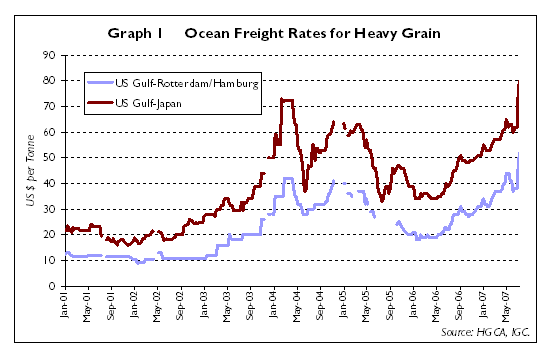 continued
For many years prior to 2003, the dry bulk cargo sector of the ocean freight market had been plagued by apparent excess capacity. The grain trade was therefore benefiting from very competitive transportation rates. Typical costs were about four times lower than current costs on trans-Atlantic grain routes. However, growth in trade, particularly iron ore and coal, as well as some port congestion, mainly in China, led to higher levels of vessel utilisation in 2003 and 2004. A rise in freight rates resulted in incentive returns for ship owners and additions were made to the dry bulk fleet. Net additions to the ocean fleet have averaged over 20Mt over the last four years, more than twice the growth rate of the four prior years (Graph 2).
continue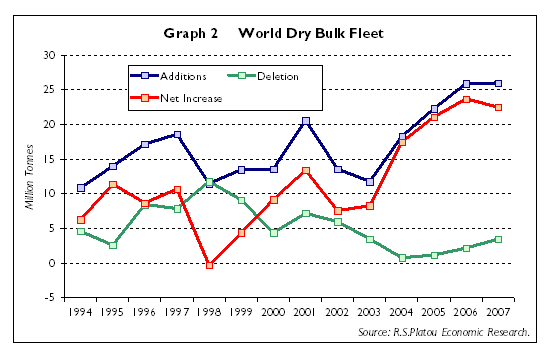 continued
Until last year, freight rates were generally trending down, albeit erratically. The dry bulk fleet was increasing over 5% a year and seemed to keep pace with growth in demand. But this downward trend has been reversed over the last 12 months. Freight rates on the US Gulf - European ports route have increased from about US$24.00/t a year ago to US$52.00/t in late July, rising very steeply in recent weeks. Rates on this route reached US$42.00/t in March 2004.
Dry bulk sector: grain and oilseed freight rates influenced by vessel shortage for other industries
Grain and oilseed trade represents only 10% of the total bulk ocean freight market and is declining. The volume of grain trade is relatively stable between years, although it can be quite seasonal on certain routes. Relatively small vessels up to Panamax size (60,000t to 70,000t) tend to be used as cargoes’ starting places and destinations are dispersed, more than for other sectors of the freight market.
The ocean freight market is driven by the iron ore, coking coal and steel sectors which are largely complementary to each other and represent about half of bulk cargoes. Those sectors have shown most of the growth in trade but are also raising most concern over future prospects for continued growth. The major contributor to the ocean freight market is China, mainly thanks to its expanding steel production which has risen from under 25% of world output to over a third in the last three years. This major portion of the market has starting places and destinations more centralized than others. Thus, larger vessels (Cape size, 120,000-130,000t) and more specialized onshore facilities are used.
Freight rates on Cape-sized vessels have been more volatile than on Panamax and smaller vessels in recent years. The former also appear to have led the latter (Graph 3).
continue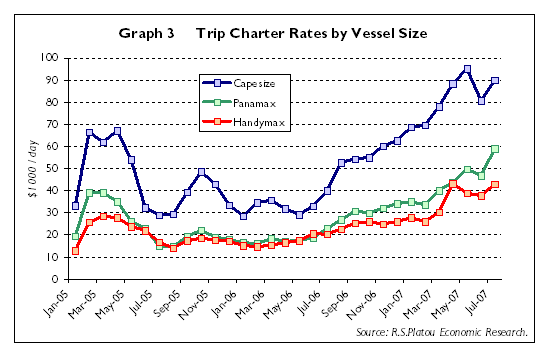 continued
The capacity of both floating and onshore facilities of the Cape market has been frequently under pressure. In particular, in relation to the growth in the Chinese steel trade, onshore facilities have proved to be manifestly inadequate to manage congestion at ports. Port congestion appears to be most serious at Australian coal and iron ore loading facilities. Although the situation has improved slightly, typically about 140 vessels have been laying at anchor waiting to load coal at east coast Australian ports during 2007. This is about twice the number waiting in years prior to 2007. Reducing these queues would increase the effectiveness of the existing fleet. But such a solution is probably not quicker than building more vessels.
The tight supply situation in the Cape-sized/steel trade related sector, affected mostly by those port congestions, was soon reflected in the more general Panamax and smaller-sized vessel sector of the market. Indeed, coal and iron ore shippers sought alternatives to Cape-sized vessels opting for smaller ones. Hence, costs to the grain and oilseed trade have increased and any immediate relief of freight rates is not anticipated. In the longer term, more vessels, and/or improved inland facilities, and/or a slow down in the growth in Chinese steel production would resolve the situation.
The tight cereal situation have driven freight rates upward further
In recent weeks, the grain sector had evolved independentely from the rest of the dry bulk market. A surge in purchases by key importers has resulted in increased freight booking from North American ports in July. Even when supplies from the EU and the Black Sea regions are much less abundant this year compared to last season and virtually no Australian wheat is available. Indeed, North African and Middle Eastern wheat importers could not rely on their usual European and Former Soviet Union suppliers due to this year’s grain shortage. The volumes may not be large relative to iron ore and coal but they may well have had a significant impact on prices as the ocean freight supply situation was so tight.
This season, grain exports do involve longer distances and add to overall demand for ocean transport. However, the surge in business is not expected to be sustained and may simply be the forward movement of ongoing business. Therefore, there may be a relative lull in the booking of grain cargoes later. Ultimately, it will be the larger iron ore/coal/steel sector of the dry bulk cargoes market which will determine the future of ocean freight rates which at the moment is very uncertain.
David Walker 001 780 434 7615
top of page